

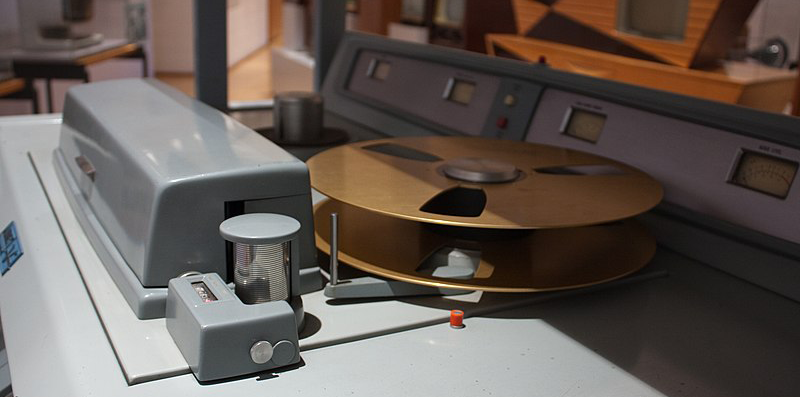
It’s easy to forget that audio and video cassettes are simply open-reel, magnetic tape on spools, housed in a convenient carrying case. But while cassette housings were first introduced in the 1960s…
- 1962 Philips introduced the compact audio cassette
- 1969 Sony premiered the commercial video cassette
…their open-reel predecessors dominated high-end media production throughout the mid-1980s. A Game of Inches Not until 1986 did open-reel audio and video formats begin to wane in professional media facilities.
- 2” Quadruplex Video and 2” twenty-four track Audio
- 1” Type C (and to a lesser extent, the specialized 1” Type B) and 1” sixteen-track Audio
- ½” 2-track and 4-track Audio
- ¼” 2-track Audio
Every professional studio and broadcaster owned these formats — churning out hours upon hours of source elements, sub-masters, protection masters, and dubs — while leaving you holding the bag.
- 30 years of open-reel video tapes are approaching 60 years old. We’ve mentioned 2” Quadruplex and 1” Types B and C, but we haven’t mentioned the non-professional EIAJ formats EIAJ-1 and EIAJ-2. Hundreds of thousands of hours still exist on these analog formats; their original masters long since gone.
- 50 years of open-reel audio tapes are approaching 80 years old. In addition to the professional formats mentioned above, a surprising majority of U.S. households in the 1950s and 1960s owned a reel-to-reel recorder from Wollensak, Voice-of-America, Concord, Uher, or Norelco.
Age is Not Kind Age is not kind to any magnetic media. Even when stored properly — with careful attention paid to temperature, humidity, winding, and reel orientation — the myriad ways magnetic media degrades is sobering:
- Sticky-Shed Syndrome knows no bounds, affecting audio and video tapes alike. Simply put, sticky-shed syndrome is basic hydrolysis, in which a molecule of water is absorbed by magnetic tape. Needless to say, hijinks ensue.
- Mold and Mildew strike fear in the most fearless archivist. Mention either word to a media preservation professional and watch their eyes roll back. This is for good reason: mold must be removed before recovering magnetic media and the process of removal is arduous. Further, the slightest hint of mold or mildew portends bad tidings, as once mold spores take hold, they multiply at an alarming rate.
- Reel Warping and Degradation can happen due to temperature swings, incorrect storage, and outright physical damage. Once warped, a reel must not be used for playback, nor can it be used to unwind on to a new, unwarped reel. The only solution is disassembling the warped reel and carefully transferring to another disassembled reel to avoid irreversible edge damage.
- Desiccating Flange Foam is an unforeseen bane of late-era 2” Quadruplex and both types of 1” open-reel video tapes. Upper reel flanges were lined with a layer of open-cell foam. This was a fine idea when the tapes were new, but over time the foam desiccated, sprinkling tiny particles within the tape’s windings. If that wasn’t bad enough, the adhesive holding that foam in place either became exposed or seeped through the foam, depositing itself on the tape’s surface like Sticky-Shed Syndrome on steroids.
This short list of maladies is what can occur if you store your media reasonably well. Be Afraid Are all your open reel tapes wound tails-out to avoid print-through? Are all your reels stored on edge so that no flanges are parallel with shelf surfaces? Most of all, do not attempt playback of open reel media without first inspecting every inch by means of slow-winding. Open reel video heads spin at rates between 3,600 and 14,400 revolutions per minute, effectively abrading the very oxide embodying your irreplaceable images. There’s a good chance your open reel media is older than you are. For that reason alone, content recovery is now or never. Enlist professionals in the field of AV Conservation to assess and preserve what’s left of your media before it’s too late.