

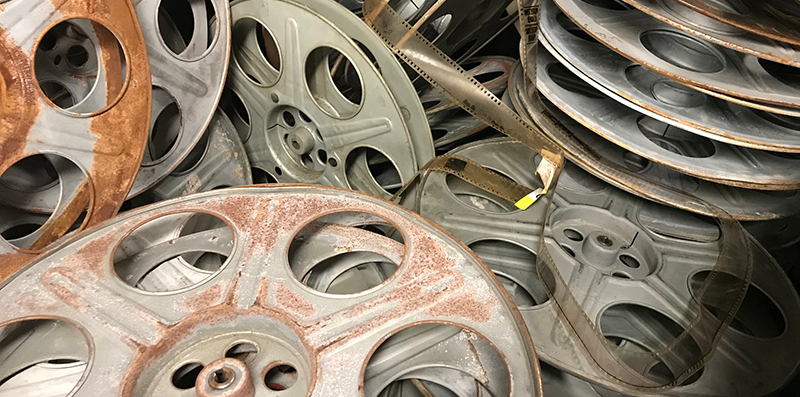
We all have one: the shoebox, shelf, or sea trunk of obsolete media to be digitized.
We thought we’d get to it one day soon, but that became next year, and now you’re not sure when. Professionals are not immune to this. Preserving media takes funding and funding takes time. Time, however, is media’s nemesis.
Time is Media’s Nemesis
Time causes media to become brittle. Brittle media is easily damaged and repair often results in sacrificed slivers of content, lost forever. Time is indiscriminate and unkind to all media.
It Gets Worse
Just as dog years differ from a human, your media’s chronological age is just the first number in an equation that guesstimates how soon your media will become unrecoverable.
- Temperatures above 68°
- Humidity below 40%
- UV (ultraviolet light)
- EMI (electromagnetic interference)
These and other overlooked factors accelerate content’s one-way march from tangible to nonexistent. Don’t ask how close magnetic media comes to reaching its Curie point in a non-ventilated space. It’s downright frightening.
But Your Media Storage is Different
- You have consistent, year-round temperature control and unwavering humidity levels.
- Each media type is stored vertically or horizontally based on its physical characteristics.
- Stacking heights are kept below crush-damage thresholds, and
- All lighting sources are cool, non-heat generating, and UV filtered.
- There’s no risk of static electricity because the mesh embedded in your floors run to dual earth grounds. No dry winter shocks in your facility!
But Alas
All our facilities lack in one aspect or another.
- Our shoeboxes, shelves, and sea trunks harbor the same corrosive atmosphere inside, as exists outside their boundaries.
- Even worse, moisture is absorbed by media stored in air-restricted cases and canisters, making the very enclosures issued by OEMs favorable to devastating mold growth.
- The faintest mold sighting or fleeting whiff of dank off-gassing, triggers dread in the staunchest archivist.
We Now Know
- Non-ventilated film degrades at an alarming rate
- Dyes fade disproportionately causing irreversible color shifts
We’ve had a much longer time to learn from and decelerate film’s degradation. The first roll of film premiered in 1885, a century before we learned how to make magnetic audio and video tape that didn’t disintegrate from Sticky Shed Syndrome.
Watershed Years Have Emerged
- 35mm before 1952
- 16mm before 1981
- Pre-1973 Audiotape
- Pre-1985 Video
Media from these eras are considered most at-risk. Attempts at their recovery are foiled by misinformation, destructive home remedies, and urban legend. Every day, minutes of media disappear forever in the form of fading dyes and masking tape splices, weakened gauss and flaking oxide.
While our necks and knuckles betray our true age, it’s easy to forget and easier to ignore media stored down the hall, in the basement, or offsite. It’s inconceivable that our 35mm has become 17mm, or a 30° temperature swing triggered an autocatalytic event, adding 350 years to our media’s effective age as it chemically feeds upon itself.
It’s Not All Doom and Gloom
It’s simply inevitable; and as with all things inevitable, like death and taxes, proper planning precludes poor performance.
- Accept that your media isn’t getting any younger.
- Accept that you must do something about it; not one day soon or next year.
- Do something about it now.
- Learn all you can.
- Gather all media right away, and
- Enlist professionals to inventory and prescribe preservation options.
A well-equipped AV conservation firm can rescue hundreds of media hours per day. With that done, you can focus on content licensing, monetization, and a better use for your shoebox and sea trunk.