

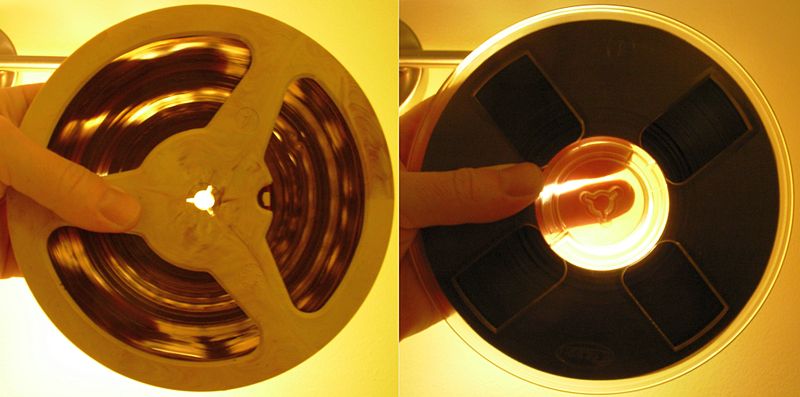
Regardless of how well your video and audio tapes are stored, it’s just a matter of time before they fall prey to the scourge of all magnetic media: sticky-shed syndrome. Pre-1985 media is especially at risk of becoming unrecoverable. Even your newer digital tapes if not stored well, risk permanent loss of content.
A Scourge Without Prejudice
Sticky-shed syndrome lays waste to every magnetic-media format without prejudice:
- Audio or Video – It does not matter what type of content is recorded on the magnetic-tape media. Audio tape’s relatively-low, sub-20,000 Hertz frequencies and video tape’s much higher 4.2-million Hertz frequencies are equally prone to sticky-shed syndrome.
- Analog or Digital – It’s easy to forget that magnetic tape is capable of recording either analog or digital signals. The tape’s formulation, particularly its binder, is the primary variable in its ability to record high-frequency digital signals. Even so, neither analog nor digital tape is immune from sticky-shed syndrome.
- Cassette or Open Reel – Often viewed as vastly different due to their physical appearance, one must remember that all cassette-based audio and video formats are simply open reels placed in a convenient housing. This cassette housing, however, provides no protection from the onset of sticky-shed syndrome.
- Oxide or Metal – Pre-1983 audio tape and pre-1986 video tape was ferric (iron) oxide – Fe2O3 – which is notably more prone to sticky-shed, even when stored carefully. However, while subsequent introduction of metal tapes with improved binders for both audio and video may have prolonged the time before sticky-shed syndrome develops, the best environmental conditions merely delay but do not prevent its appearance.
- Helical or Linear – Video tape may have been first to be helically scanned, but for audio tape to offer digital’s benefits in a small package, it too needed the faster writing speeds of helical recording. Helically-scanned tapes, however, are prone to the slightest onset of stick-shed. One need only hear the sickening, audible screech as tape passes by an R-DAT’s dual 2,000 rpm heads, a 1” Type C’s four 3,600 rpm heads, or the eye-watering 14,400 revolutions per minute of 2” Quad’s transverse headwheel, to know you’ve damaged both your media and machine.
Optical Media Is Not Immune
Your optical media is also at risk from a silent killer.
- Videodiscs and DVDs use a similar metallic data layer embedded in a polycarbonate substrate. Even stored correctly, these formats are subject to oxidation and data loss.
- Audio CDs and CD-ROMs use an aluminum data layer which is prone to corrosion. Temperature and humidity variations not only accelerate this process, but risk warping or clouding the polycarbonate substrate making data recovery nearly impossible.
- CD-Rs and DVD-Rs use organic, photosensitive dyes which decay at an alarming rate. In fact, we’re learning that recordable optical media may degrade faster than their magnetic media counterparts. Lest your discs be made of gold – yes, that’s a thing – or better yet, inorganic stone – that’s a thing too – your discs may be unreadable in fewer than 10 years.
The Solution
No matter what media format you have, it is silently degrading.
- Review how you’re storing each media format.
- Ensure your storage environment remains cool and dry year round.
- Use only archival-grade cases and vented canisters.
- Repair sub-standard splices and re-pack all media via slow-winding.
- Store magnetic media tails out and film with heads out.
- Use ample leader at the head and tail of both magnetic media and film.
Finally, talk with the professionals at AV Conservation to preserve what’s left of your media before it’s too late.